About the Journal
About IJSSASS
Languages: French and English
Accessibility: Open Access
Plagiarism Checker: Plagiarism X
Submit article to ijossasseditor@gmail.com
The International journal of social sciences and scientific studies (IJSSASS) is an international bi-monthly peer-review journal. IJSSASS has been at the forefront of scholarship on general education and, encouraging research and reflection on a range of disciplines in the general spectre of social sciences and sciences pertinent to Africa. Founded in 2013 under a cooperate educational consultancy firm called FETA, IJSSASS aims to serve as the forum where original research is presented and to shape the discussion of the most important and topical issues through a rigorous scholarship selection and editing process. Meeting the highest international standards, IJSSASS is published in English and French language, thus engaging in an international dialogue about education and safeguarding that its content is widely disseminated.
Coverage: Theology, Psychology, International Relations, Politics, Social Welfare, History, Public Administration, Law, Sociology, Anthropology, Information technology
Publishing Ethics
Plagiarism in all its forms constitutes unethical publishing behavior and is unacceptable. The journal has no tolerance for plagiarism. All submitted manuscripts must go through cross-checking using a Plagiarism Checker.
Important Dates- 
Articles Submission Open for Volume-5 Issue-4 September 2025
Last Date of Article Submission: 1st August 2025
Date of Notification: 20th August 2025
Date of Publication: 29th September 2025
Current Issue
Vol. 6 No. 5 (2026): Legal and Society
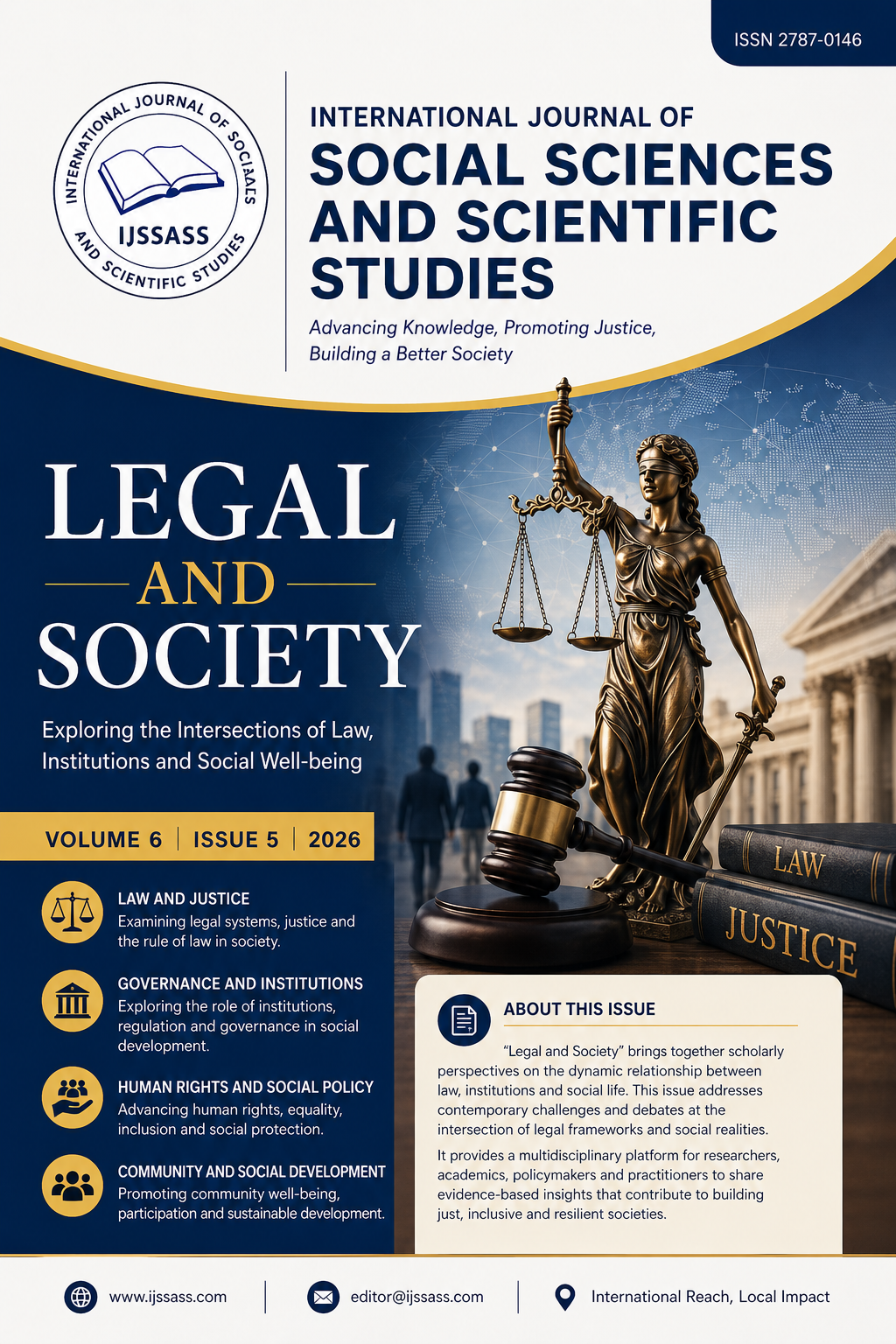
Legal and Society examines the dynamic relationship between law and the societies in which legal systems operate. This issue brings together multidisciplinary research exploring how laws, legal institutions, governance structures, and social values interact to influence justice, human rights, equality, and social development.
The issue addresses contemporary legal and societal challenges, including law and justice, governance and institutions, human rights and social policy, and community and social development. It provides a platform for researchers, academics, policymakers, and practitioners to present evidence-based perspectives on the role of law in addressing social challenges and promoting fair, inclusive, and sustainable societies.
Volume 6, Issue 5 (2026) contributes to broader scholarly discussions on how effective legal frameworks and institutions can strengthen social well-being, accountability, human dignity, and sustainable development.
Keywords: Legal and Society, Law and Justice, Governance, Human Rights, Social Policy, Legal Institutions, Equality, Social Development, Community Development, Public Policy.
Published:
2026-09-03